Spring Farm Public School

2020 Newsletter Term 1

Upcoming Events

Wednesday 29th JanuaryYears 1 - 6 Students Return
Wednesday 29th Jan to Tuesday 4th FebruaryKindergarten 2020 Best Start (refer to individual child appointments)
Wednesday 5th FebruaryKindergarten First Day for 2020
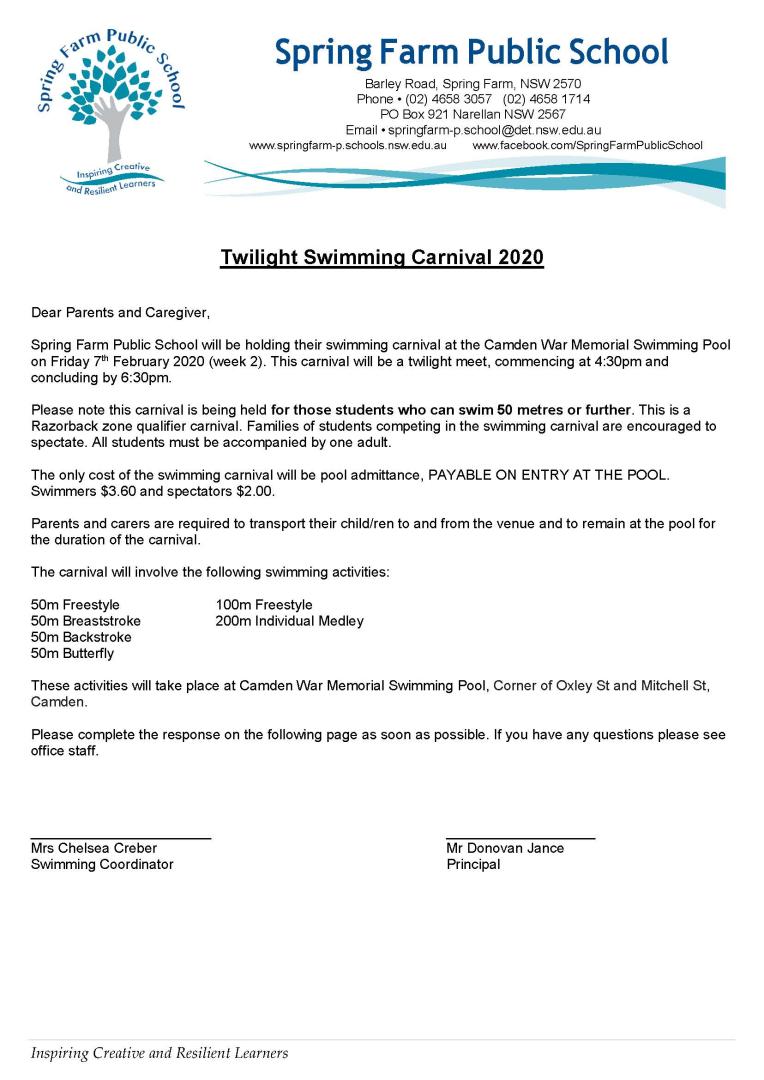
Friday 7th FebruaryTwilight Swimming Carnival
Monday 3rd & Tuesday 4th MarchMeet the Teacher Evening (further information to come)

From the Principal

Dear Parents and Carers,

Welcome to Spring Farm Public School 2020! We have a lot to look forward to and to celebrate throughout this year!

Due to limited participants, Spring Farm Public School will not be participating in the 2020 Australia Day March.


On Tuesday 29 January 2020, teachers and staff officially return to school. They will be participating in professional learning activities and will be addressing a number of Department of Education policies and procedures.

Students in Year 1 to Year 6 students will start school Wednesday 30th January 2020

Please drive carefully and park correctly around the school. We are encourage all students and families who enter the school to cross at the Childrens Crossing where there are bright fluoro flags up on Barley Road, near the school’s Electronic Sign.


School gates will open from 8:30am. Students and their families are asked to wait around the green zone (for Year 1 to 2 students) and Primary students (Years 3 to 6 students) to meet in the blue zone where they can all meet and greet their peers and play quiet games such as hop scotch or handball. Due to the amount of people in this area, playing with soccer or rugby balls or running around, is prohibited.


At 8:55am all students will be asked to line up in their stages: under the COLA (Years 1 and 2) and Blue Zone (Years 3-6). Signs will be placed to indicate where to line up.


The Assistant Principals for each stage will address the assemblies. They will place students into their temporary classes. Students will wave goodbye to their parents and family and they will depart with their teacher into their new classes.


Due to safety concerns and the amount of students and staff around the walkways, we ask all parents and carers to stay in the playground areas and not go with their child into their classroom, as they often settle quicker with their peers in the new class.


Year 1 to 6 students in our Support Unit classes, will go straight into their classroom after the short welcome assembly.


Parents and carers can pick up their child or children at 2:55pm in the green zone where they will be able to meet their child’s teacher.


Canteen will be open for parents or carers to organise lunch orders and breakfast will be available. The Canteen will be open at lunch times for students to purchase light snacks and ice blocks.


Kindergarten students will be doing their Best Start assessment throughout the first week of Term 1. Please be familiar with the information from the Best Start letter and stick to the times allocated for your child. On the day of Best Start assessment, parents and carers will receive a letter outlining the times and procedures for their child to start Kindergarten.


As we are a growing school, classes will be temporary for the first few weeks of this term. Class changes may eventuate due to an increase of enrolments throughout the year. Thank you for your understanding.


The next newsletter will be published at the end of week 3, 6 and 9 of each term.


Donovan Jance

Principal
Information Videos

Below are some videos the students and Mrs Evans have prepared explaining some of the procedures at SFPS.

Kiss and ride

https://youtu.be/REkeO_D9ogg

Assembly awards

https://youtu.be/pO0jEFnc6E0

Late or absent from school

https://youtu.be/s1d36IWGAlU

Playground expectations

https://youtu.be/L-Kv_JDW35c

Communicating with the school, class teachers and staff

If you need to communicate to the class teacher or another staff member, these are the options:

  • Anything urgent, please ring the school and that message will directly be passed onto the class teacher
  • Email the school and the office staff will send it to the correct class teacher. Class teachers are busy teaching their class and will look at their emails at least once a day. They will contact you via phone as soon as possible and if they are unable to reach you, they will leave a message or respond via the school email
  • If you require an acknowledgement of the email being read, please use the receipt option when emailing the school
  • Please see the class teacher in the afternoon at dismissal time
  • Contact the office via the phone and they will contact the class teacher for them to call back or contact you via the school email to arrange a meeting


The school utilises Class Dojo, SeaSaw app and school facebook as school learning journal. Due to WHS and privacy laws, the Comments and Messenger components on these apps will not be activated.  This will also ensure that your messages and any concerns can be addressed in a timely fashion by contacting the office so your messages can be passed onto right staff.


Please do not ask questions via the school’s facebook page as it is a learning journal only. 

Keeping up to date with school events

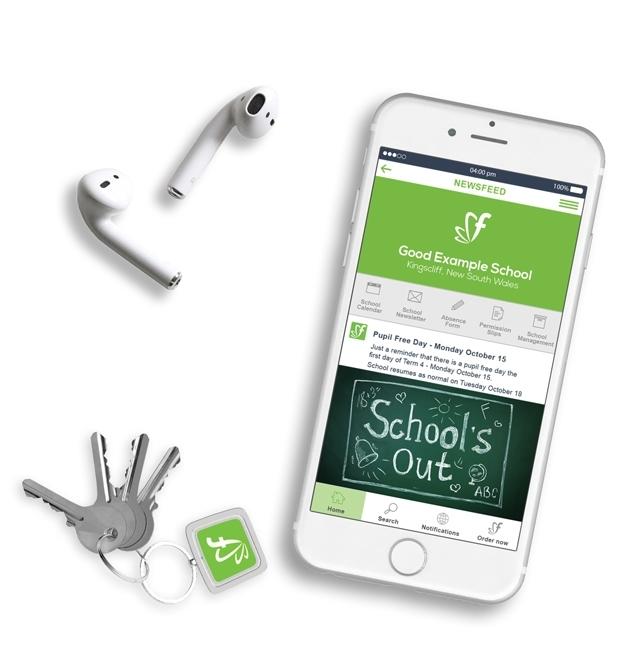
Please keep referring to your skoolbag app and the school’s website for alerts, updates and up and coming events. If you are unsure of something and cannot find the information on the app or on the school’s website School Calendar tab, please email the school and we will get back to you as soon as possible.

Successful morning and dismissal routines

A reminder that school gates and teacher supervision commences at 8:30am. This is important for the safety of students, as there is no supervision prior to 8:30am.


I also ask for all parents and carers to enter the school grounds from 2:45pm onwards if they are picking up their child or children at 2:55pm. Due to Work Health and Safety requirements, entering the school grounds earlier than 2:45pm, you will be required to sign in at the school office. Thank you for your understanding in this matter. 

Break times

The school has increased the times of the Brain Breaks (each class goes out with a buddy class for structured play for about 20 minutes between 10am to 11:30am). This has had enormous benefits as students and staff are having a break between their academic learning and are participating in more play base learning.

Similarly, the school has been trialling a more supervised eating time for both lunch and recess breaks. As we are a large and growing school, we have had to consider the safety of all students and staff especially when dismissing them for play time. Therefore, a number of stages and individual classes have a specific meeting points to eat or to line up at various parts of the school. This has reduced a number of accidental student injuries when students were dismissed for play; teachers are able to monitor smaller groups of students eating and finishing their food and placing rubbish in the bins which has greatly reduced the litter on the school grounds.

As the school continues to grow or weather events need to be addressed, we will continue to review and revise break times for students and staff.

Signing your children out of school

When you need to take your child or children out early from school please go to the office to have your ID checked and wait for your child to come to the office.

The office staff will contact the class teacher to arrange your child or children to come to the office. If no one is in the office, please stay there until someone returns.  Due to safety and privacy laws, it is imperative that parents and carers stay in the office and not go to the class when you need to take or pick up your child or children.

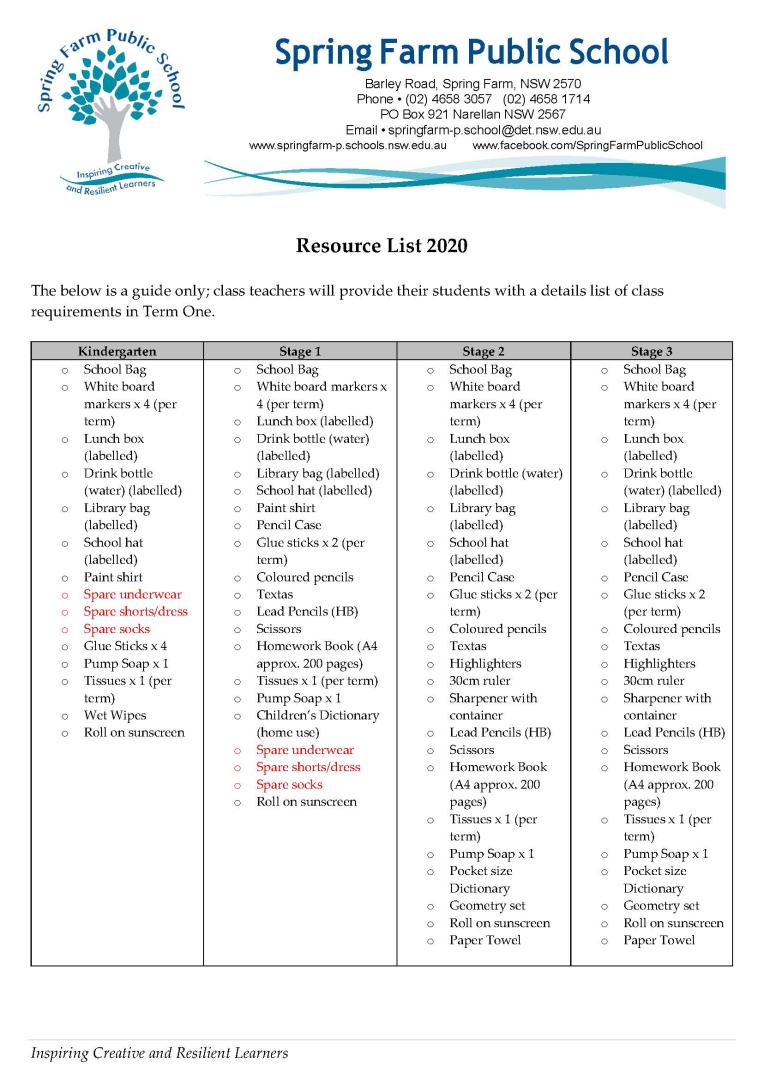
2020 Resource List - Guide Only

Twilight Swimming Carnival 2020

Information for parents and carers

Large scale distressing events impact our communities in many ways. As with the drought, the recent bushfires have impacted a number of our communities and have been unsettling and stressful for many students. Children cope with traumatic experiences in different ways and there is no one ‘standard’ pattern of reaction. If you are concerned about your child, it’s important to discuss your concerns with their teacher(s) and seek support from the school counsellor or other professionals you know.


Distress may be related to:

  • having been directly at risk/exposed to fires (loss of homes, pets, personal belongings)
  • being concerned about family or friends
  • being exposed to distressing media coverage including injured wildlife, and
  • feelings and memories resulting from previous experiences and other instances of grief and loss.


There is no such thing as a typical reaction. Some may show much distress or they may ask many questions and appear preoccupied with the event. Some of these reactions may appear immediately but others may not show themselves for weeks or even months later.


Some reactions may include sleep disturbances, regressive behaviour (thumb sucking), nightmares, fear of the dark, clinging to parents/carers, loss or increase in appetite, physical complaints that have no medical basis, aggressive behaviour, competition with sibling for parental attention, withdrawal and/or loss of interest in regular activities.


Children look to the significant adults in their lives for guidance on how to manage their reactions. Parents and teachers can help children cope by remaining calm and reassuring them that they will be all right.


Children are usually very resilient and for most children these reactions will gradually reduce over time with the support of families. After a traumatic event, children need comfort, reassurance and support, and to know that they are safe and are being looked after.


How you can support your child

  • Children need comfort, reassurance and support, and to know that they are safe and are being looked after. Try to spend more time with your children and provide them with plenty of affection through cuddles and hugs.
  • Let them be more dependent on you for a while and try to re-establish daily routines, for example routines around mealtimes, bedtimes and returning to school. Keep to your regular routines and activities as much as possible.
  • Listen to your children’s concerns. Listen closely to what they are asking or saying, and if they are looking for factual information, or if the questions are expressing anxiety about the bushfires. Try to keep your own feelings to yourself when talking about their feelings. Let them know that you understand how they feel. Correct any misunderstandings or confusion.
  • Keep your responses appropriate to the age and emotional maturity of your child. Young children often need reassurance more than facts.
  • Monitor their exposure to television/social media stories regarding the fires. Children can be distressed by watching repeated images. Explain to them that it may not be a good idea to keep watching repeated images.
  • Include your child in planning any changes resulting from the current situation.
  • Support your child to stay connected to friends.
  • Be aware of how you talk. Adults need to be conscious of the presence of children when discussing the effects of natural disasters. It is a good idea not to let children overhear adult conversations about worrying things if they cannot join in at their own age or stage of development.


Most importantly, look after yourself. When you are feeling cared for you are better able to respond to the needs of your children.


Where to get help

While most children will bounce back after a traumatic event, some children may show prolonged distress and may benefit from professional support. Please contact your school to discuss the most appropriate support for your child.


If you would like additional support, the following services are available:

  • The school counsellor
  • Your local GP
  • Kids Helpline – 1800 55 1800 – kidshelpline.com.au
  • Headspace – 1800 650 890 – eheadspace.org.au
  • Parent Helpline – 1300 1300 52
  • Beyond Blue – 1300 22 4636
  • Mensline – 1300 789 978
  • Lifeline – 13 11 14

P&C News

The next Spring Farm Public School P&C meeting will be on Monday 17th February 2020 at 7pm in Block A of the staffroom.  All parents and carers are welcome to attend.


The AGM is being held in week 8 of Term 1 on Monday 16th March, where all executive positions will be declared open and all financial members are able to nominate and vote in the 2020 P&C for Spring Farm Public School.

Canteen Online Ordering

 The school canteen has online ordering now available; please download the Flexischools App on your phone to utilise this optional service.

For further information visit: https://flexischools.com.au/mobile-app

2020 Fresh Starts Canteen Menu

Due to increased enrolment numbers at Spring Farm Public School, Fresh Starts Canteen's menu has changed to better accomodate our growing school.

Community Information

Instantly translate our newsletter to ANY language

With Google Translation integration, you can access our newsletter in ANY language. Simply scroll to the bottom of the newsletter preview to give it a try.